



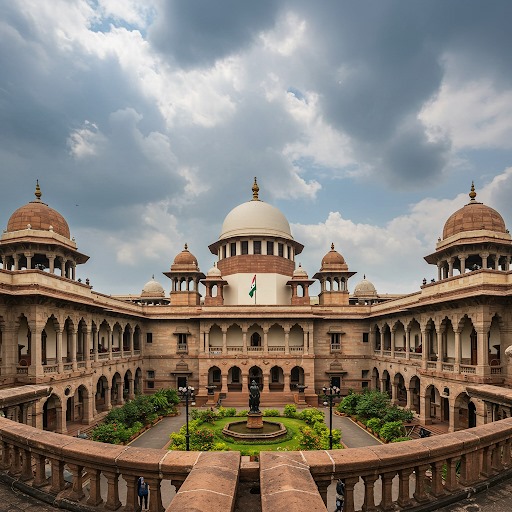
On Friday, February 22, the Supreme Court issued a stay on the National Company Law Appellate Tribunal (NCLAT) order that had permitted National Building Constructions Corporation (India) Limited (NBCC) to take over and complete the pending real estate projects of Supertech Limited. The Court also instructed all relevant stakeholders to present alternative proposals for the completion of these projects.
The bench, comprising Chief Justice of India Sanjiv Khanna and Justices Sanjay Kumar and KV Viswanathan, was hearing a challenge against the NCLAT order, which had approved NBCC’s proposal to take over the construction of 16 stalled projects belonging to Supertech Limited. These projects, located in Noida, Greater Noida, and other cities, have left over 50,000 homebuyers in a state of prolonged uncertainty, many of whom have suffered significant financial hardships due to extended delays in receiving possession of their homes.
The insolvency proceedings against Supertech Limited were initiated by Union Bank of India, with NBCC subsequently filing an application to undertake the completion of the projects as part of the resolution process under the Insolvency and Bankruptcy Code (IBC), 2016. However, while granting the stay, the Supreme Court highlighted that the key legal issue in question was whether NCLAT had handed over the stalled projects to NBCC in accordance with the procedures prescribed under the IBC.
In light of this, the Supreme Court directed all concerned stakeholders, including corporate guarantors, the Yamuna Expressway Industrial Development Authority (YEIDA), and Supertech Limited’s promoter, R.K. Arora, to submit any viable alternative proposals by March 21 for consideration. The matter remains pending as the Court evaluates the best course of action for ensuring the timely and lawful completion of these projects.
Technical Member Mitra emphasized that NBCC could not be exempted from complying with statutory requirements, including the provisions of the RERA Act. The Tribunal cited the judgment in Bikram Chatterji & Ors. v. Union of India, which underscored the public trust doctrine, requiring the State and its agencies to take affirmative steps for effective project management.
The Tribunal further noted that homebuyers, who had already made substantial payments for their units, were entitled to recover only the unpaid dues as per their respective Builder-Buyer Agreements. It clarified that no additional costs would be imposed on homebuyers for project completion, apart from outstanding dues. Additionally, it was observed that funding for the completion of pending projects should be sourced from unsold inventory, receivables from homebuyers, and financial support from NBCC.
The Tribunal also issued the following directives:
Homebuyers will not be required to pay any additional amount beyond what is stipulated in their Builder-Buyer Agreements.
The quality of construction must be prioritized, with third-party audits conducted by reputable institutions to ensure standards are met.
The completion timeline for the pending projects must range between 12 to 36 months.
 info@adhwaitha.com